Click, Flip, Fly
For some time now, I have made a habit of turning off my outdoor lights early in the evening, so I do not add to the disorientation and disruption faced by the insects that share my yard. There is so much we can do to ease the pressure we put on the natural world, and much of it begins at our own doorstep.
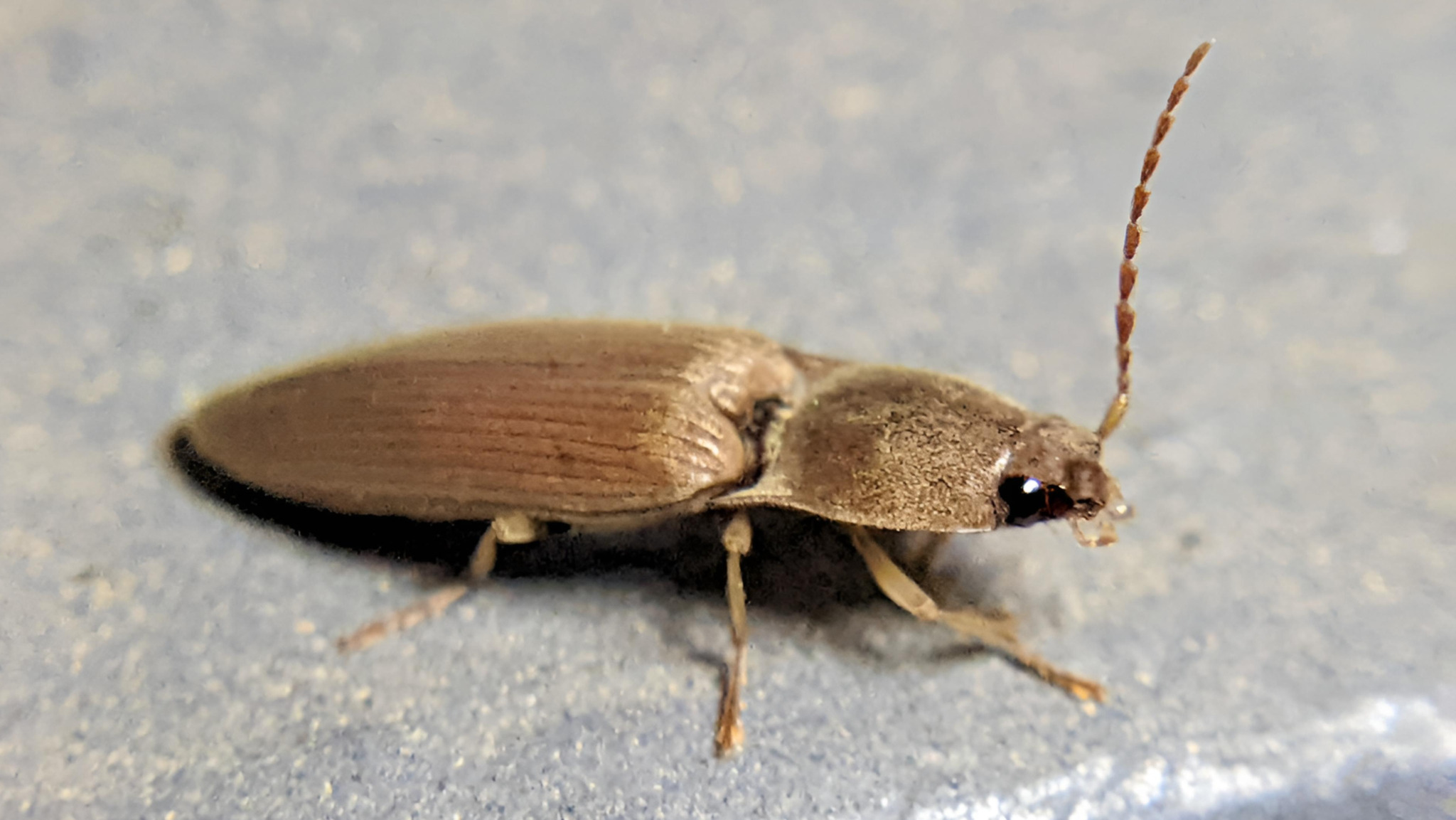
Still, if you leave a light on for even a short while after dusk, you may find a handsome visitor: a plain, hairy, brownish beetle, perhaps about the length of a grain of rice and a half, ambling across the doorstep or lying upside down beneath the bulb. To many eyes it looks like nothing much, just another brown beetle. But look closer. It is a genuinely handsome little animal, dressed in a dense coat of fine hairs that catches the light if you get low enough to see it.
Then it does something no ordinary-looking brown beetle has any business doing. It arches its back, there is an audible click, and it launches itself into the air like a tiddlywink.
It is a click beetle, one of the Elateridae. The one in my yard appears to be Monocrepidius lividus, formerly and still widely known as Conoderus lividus. The click beetles get their name from exactly this trick. A peg-like projection on the underside of the front part of the thorax catches against a matching cavity farther back. When the beetle flexes and releases the mechanism, the sudden snap can flip the whole animal into the air.
It is chiefly a way to right itself after landing on its back, but it can also be an escape move. Nothing startles a would-be predator quite like dinner suddenly popping several inches straight up.
The beetle at the light is an adult, active above ground during the summer months. What we do not see is the longer part of its life. Before it became this small brown acrobat, it spent much of its life underground as a wireworm: a hard, smooth, yellowish larva that looks uncannily like a short length of stiff wire. Like other wireworms, it moves through the soil and feeds below ground, where larvae of some click beetles can become agricultural pests.
But there is something worth pausing on in an insect that spends much of its life as a patient, wire-bodied grub feeling its way through the dark soil, only to spend its brief adult life clicking, flying, and turning up, of all places, in the small circle of light by your door.
Next time one turns up there, give it a little space. You may be lucky enough to see it right itself, with a click and a sudden spring into the dark.
🔎︎ A few papers for the curious
→ Kozlov, M. V., Prosvirov, A. S., & Zvereva, E. L. (2020). Can larvae of forest click beetles (Coleoptera: Elateridae) feed on live plant roots? Insects, 11(12), 850. https://doi.org/10.3390/insects11120850
→ Bolmin, O., McElrath, T. C., Wissa, A., & Alleyne, M. (2022). Scaling of jumping performance in click beetles (Coleoptera: Elateridae). Integrative and Comparative Biology, 62(5), 1227-1234. https://doi.org/10.1093/icb/icac068
→ Wang, Y., Wang, Q., Liu, M., Qin, Y., Cheng, L., Bolmin, O., Alleyne, M., Wissa, A., Baughman, R. H., Vella, D., & Tawfick, S. (2023). Insect-scale jumping robots enabled by a dynamic buckling cascade. Proceedings of the National Academy of Sciences, 120(5), e2210651120. https://doi.org/10.1073/pnas.2210651120
📷 Monocrepidius lividus | © Claire O'Neill; please credit accordingly.

No comments:
Post a Comment