The Fold Is the Curtain
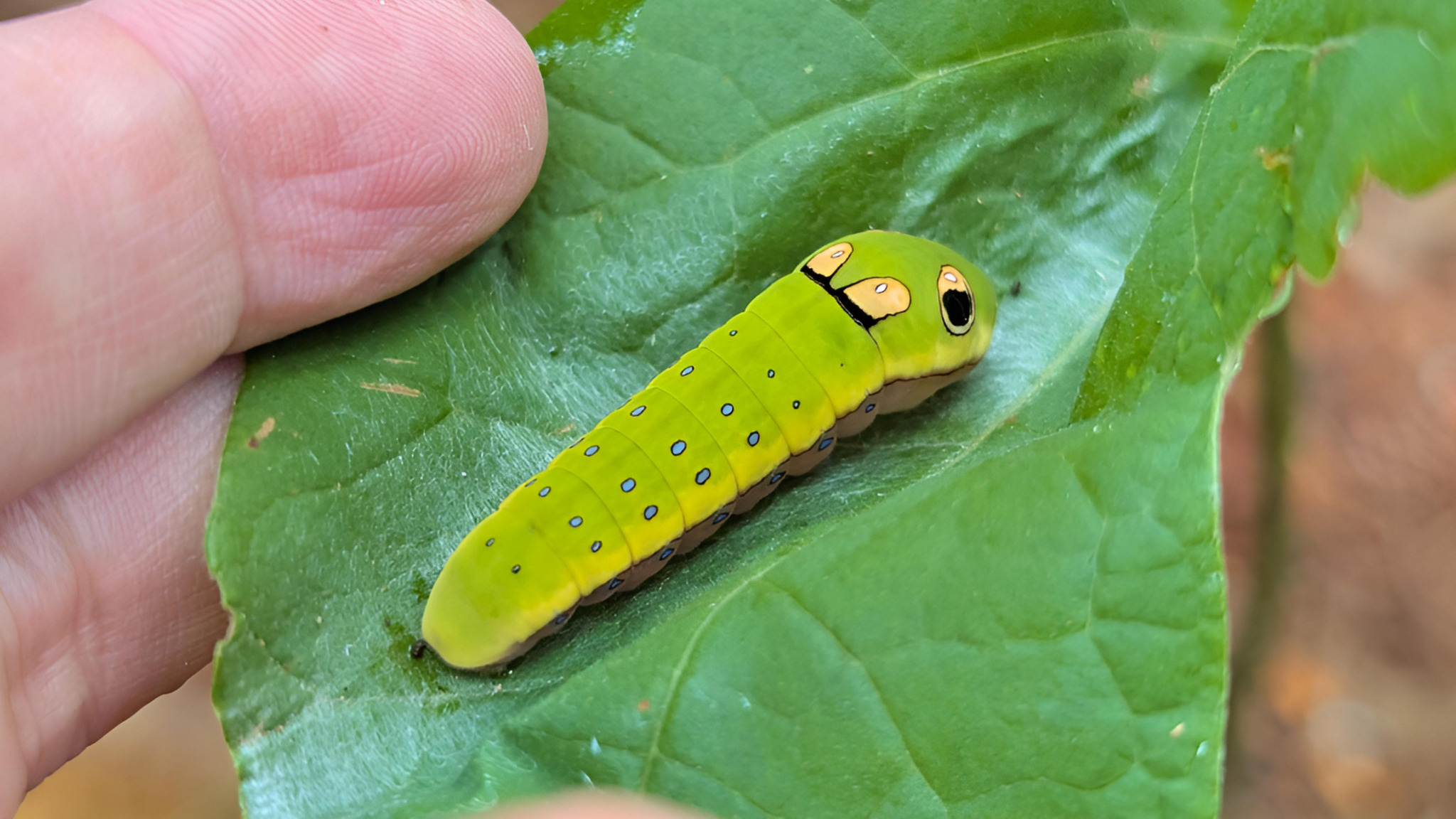
Two eyes look back at me, to which I respond with a shout of excitement, inviting Yvonne to join me and rejoice. Those “eyes” (false eyes, actually) belong to the late instar caterpillar of a spicebush swallowtail, papillon carolinien in French, Papilio troilus. It is green above, with a pale yellow line running down each side and rows of small blue dots across its back. On its swollen thorax is a pair of mustard colored false eyespots, each with a black pupil and a tiny white fleck that reads exactly like glare off something wet. From one angle it is a small green snake. From another, a tree frog. The bulge of those painted pupils makes the eyes seem to hold you no matter where you stand.
I had assumed the fold was simply shelter. But then, researching it, I discovered that it is more interesting than that. The caterpillar lies along the midrib and lays down a mat of silk. As the silk dries, it contracts, and the tension pulls the leaf edges up and over. The youngest ones may simply curl a leaf tip; older ones recruit the whole leaf. Inside, the caterpillar rests through the daylight hours, molts, and waits with its head pointed toward the petiole. It comes out to feed after dark.
Which means the eyespots spend most of their working life hidden. Which raises an interesting question: if the eyespots are usually hidden, when do they actually matter? A recent field experiment using artificial caterpillars found that, out on an open leaf, eyespots made no measurable difference to how often birds attacked. Inside a leaf fold, they did. So the fold may not only be a hiding place. It may also be a curtain. Whatever opens the leaf gets the eyes all at once, at close range, in bad light. I was, briefly, that predator.
There is a fungus in my story only because it put me on my knees at the right height. The sapling was lower than waist high, which is where the females prefer to lay in the first place.
It is nearly the end of August, and this caterpillar has already run out of season, although nothing about it looks urgent. Day length is the cue, and for this species the threshold has actually been measured: somewhere around fourteen and a half to fifteen hours of light at our latitude, less as you go south. We dropped below it here in the first half of the month. Whatever happens next has been settled by the light before I ever knelt down.
So it will stop feeding, turn yellow, and walk off the sassafras, several meters if it needs to. Then it will girdle itself to a stem. Not down into the leaf litter, which is where I would have guessed, but onto a slender stem, thinner than a pencil, low among the leaves and just above the ground. In midsummer, a chrysalis formed on a green stem can come out green. This late in the year it will very likely be brown, because the shortening light seems to override whatever the larva's eyes report about the substrate. Eight months on a twig, out in the open, being a dead thing.
I folded the leaf back, left it there, and moved away happy to know that this caterpillar had made it that far and was on its way to pupation. I wished her a safe winter, and him a successful adult life.
🔎︎ More about swallowtails
→ Postema, E. G. (2025). Eyespot peek-a-boo: leaf rolls enhance the antipredator effect of insect eyespots. Journal of Animal Ecology 94: 814-822.
→ Hazel, W. N., & West, D. A. (1983). The effect of larval photoperiod on pupal colour and diapause in swallowtail butterflies. Ecological Entomology 8: 37-42.
→ West, D. A., & Hazel, W. N. (1996). Natural pupation sites of three North American swallowtail butterflies. Journal of the Lepidopterists' Society 50: 297-302.
→ Stichter, S. (2014). Spicebush Swallowtail. The Butterflies of Massachusetts.
📷 Spicebush Swallowtail · Papillon Carolinien (Papilio troilus) | © Claire O'Neill, please credit accordingly.

No comments:
Post a Comment