I had set out with a simple plan: check a bog and maybe catch sight of pitcher plants. These days, it is never a given, as many bogs are quietly drying. When I couldn’t find a place to park, I turned back, stopped the car, looked at a trail map, noticed a cluster of nearby paths, and thought, ‘I haven’t been there’, and decided to see what it holds.
That small shift led me into a mixed pitch pine, black oak, and scrub oak maritime forest. The trail opened toward an overlook of kettle ponds and parabolic dunes, their forms shaped by a steady wind moving in one direction. Simply lovely.
As usual, covering less than a mile took me a long while. Color, texture, and form in the vegetation kept asking for attention.
With pitcher plants out of the picture in this habitat, I returned to my other thread of inquiry this week: following the movements of carpenter ants and their relatives along vegetation. A black cherry caught my eye, though not at first for itself. What revealed it were the black cherry leaf gall mites (Eriophyes cerasicrumena). Lately, it is often the tracks that introduce me to the host. Tracks have become my first keys. I have grown to appreciate this way of seeing. It echoes what I often share on walks: interactions are what make worlds. What an organism is in isolation is less than what it is within its community.
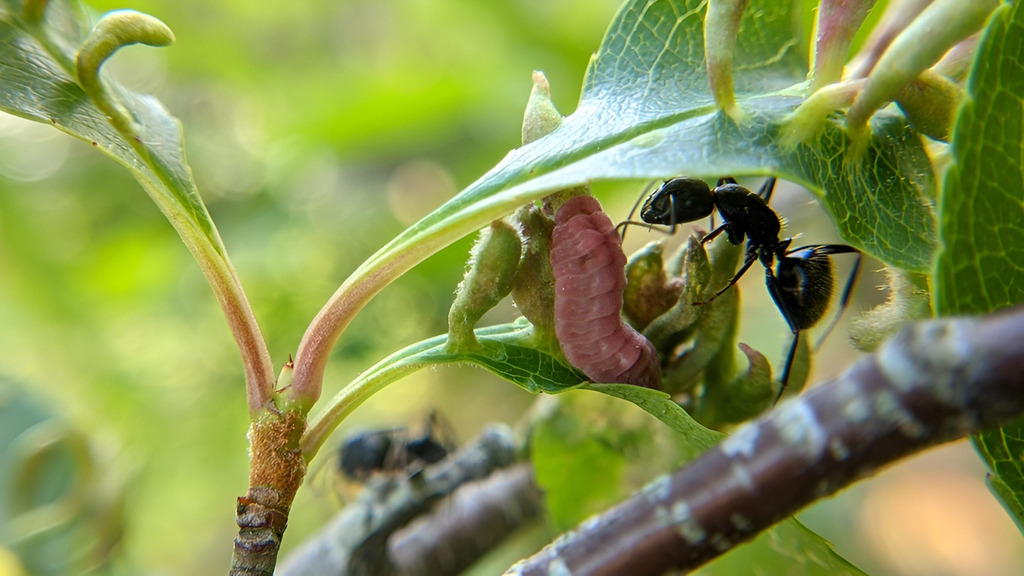
I lingered on the leaves, watching the galls shift in color from cream to a deep dusty rose. Ants moved deliberately among them. When I gently touched the twig holding those inhabited leaves, the ants responded immediately, quick and purposeful in their defense.
Looking more closely, I realized that the deeper pink or mauve forms I had been noticing were not galls at all, but caterpillars.
Using a twig to keep a respectful distance, I parted the leaves slightly. The caterpillars appeared to be feeding on the gall tissue, perhaps on the tiny inhabitants of those galls. In return, I assume the caterpillars offer the ants a sugary secretion, which would keep the ants nearby and give the caterpillars a kind of protection. The black cherry provides the site and food altered by the gall mites, the mites create the nutrient-rich structures, the caterpillars exploit those structures and their occupants, and the ants patrol and defend the spot in exchange for the sweet reward. Four species, tree, mites, caterpillars, and ants, together form a small living economy of shelter, food, and defense.
Yet as I watched, another question emerged: what is the black cherry getting from all of this?
I have since logged the observations and am waiting for confirmation. Whether or not the identification holds, the moment stands on its own. It was a reminder that attention shapes what we find. Plans may guide us to a place, but it is the openness of mind and senses that reveals what is already there.
📷 Cherry Gall Azure · Azur des Phytoptes du Cerisier (Celastrina serotina) | © Claire O'Neill, please credit accordingly.

Stunning photo!! What a discovery to notice such tiny and amazing connections on a black cherry leaf. Thank you for being you and being there in that moment. Your sensing abilities and way of walking in nature are lovely.
ReplyDeleteThanks, for the kind words :D
Delete