The Annual Reunion of a Bee, a Plant, and One Who Pays Attention
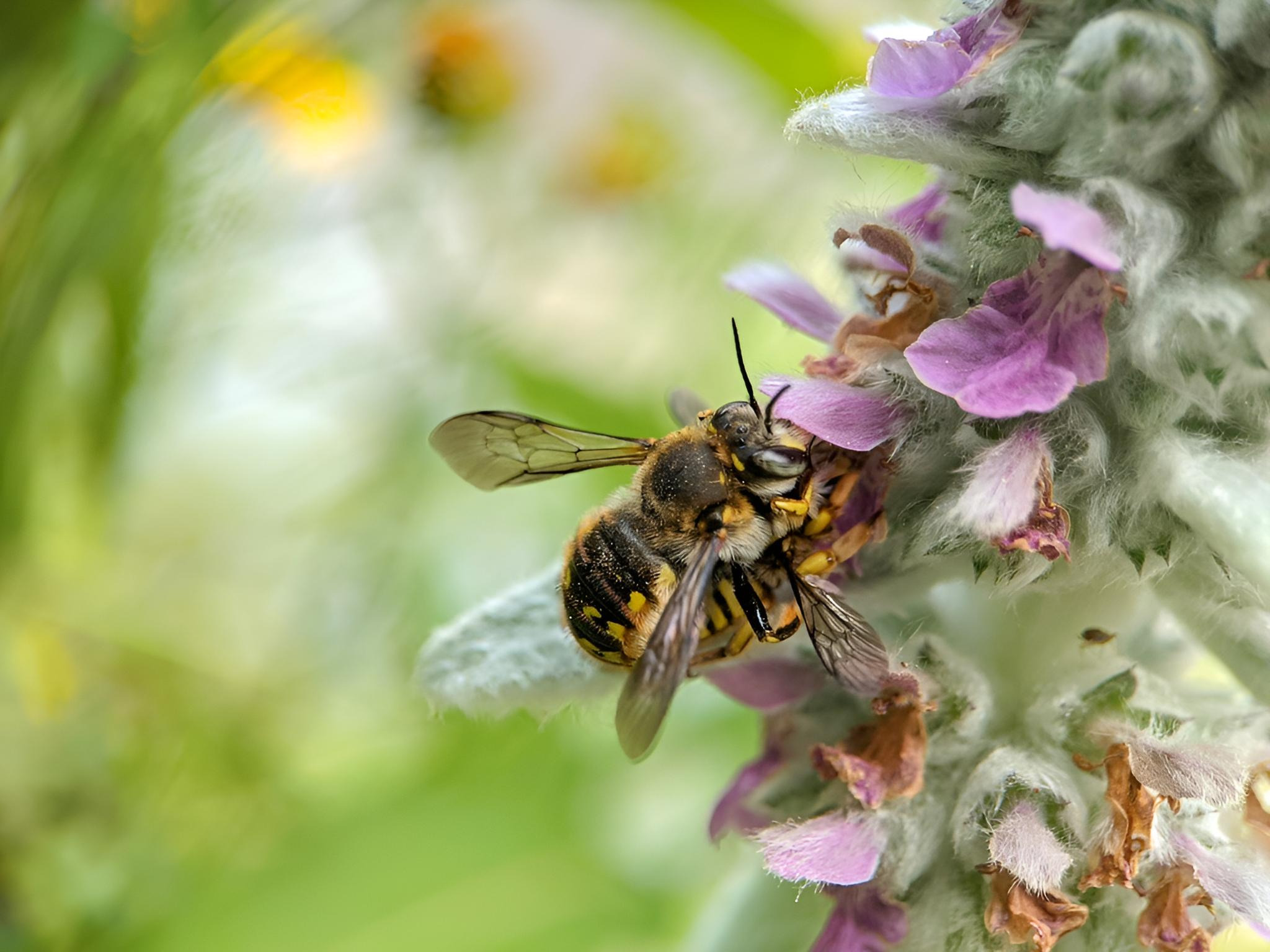
I do not keep rigorous phenology records for my little patch of lamb's ears (Stachys byzantina), though perhaps I should. Still, I pay attention.
Every year, a moment comes when the soft silver leaves send up their flowering stalks and the first flush of purple appears. I am not entirely sure whether those purple parts are petals or sepals, but the effect is always the same: as soon as I see that color, I feel a small jolt of anticipation, because I know the wool carder bees are on their way.
Not long after the flowers begin to bloom, there they are. It felt as though I waited a little longer this year, and I should probably record the interval between flowering and the bees' arrival. The lives of solitary bees are brief, and the individuals I see today are almost certainly descendants of those I watched last year, continuing a relationship that has likely persisted in this small patch for generations.
The male wool carder bee (Anthidium manicatum) is usually the first one I notice. This year, I spotted him patrolling a nearby patch of beardtongue before returning to the lamb's ears. He saw me and hovered at eye level, impossibly confident for a bee scarcely larger than a fingernail. There is something almost confrontational about the way he faces me, suspended in the air as though evaluating whether I belong in his territory.
"Hey, woman. Leave my patch and my girl alone. I am watching youI"
Male wool carder bees are famous for this behavior. Rather than defending a colony, they defend patches of flowers rich in nectar, chasing away rivals and almost anything else that enters their airspace. Few bees make their territoriality so obvious.
Soon his attention shifted to a female moving among the flowers. He rushed toward her with an enthusiasm that seemed only partly welcome, while she carried on with the business at hand. She fed among the flowers and visited the leaves, scraping their soft hairs with her mandibles. Those fibers will line the brood cells where the next generation develops, giving wool carder bees their name.
What fascinates me is that both bee and plant arrived here from elsewhere. Lamb's ears originated in western Asia. The wool carder bee evolved across Eurasia and was first recorded in North America in 1963, and has since spread widely. Yet they arrived carrying an old familiarity with one another. The female still gathers the woolly fibers. The male still patrols the flowers. Behaviors shaped long before either reached New England.
A plant and a bee, both far from their ancestral ranges, still performing behaviors shaped by a much older evolutionary history. The female gathers plant fibers. The male patrols his territory with grand confidence.
And I find myself watching. The purple appears. The carders return.

The story of the wool carder bee and lamb's ears is a lovely illustration of ecological fitness and evolutionary history.
ReplyDeleteIn their native ranges across parts of Europe and western Asia, these species did not "find" one another in the sense of a recent discovery. Rather, they emerged within overlapping ecological communities over thousands of generations. The wool carder bee evolved a remarkable behavior: females scrape the dense hairs (trichomes) from plants, especially Stachys species, to line and protect their brood cells. Lamb's ears, with its thick silver felt of hairs, is one of the most sought-after sources.
The bee's attraction to Stachys is therefore not arbitrary. Natural selection favored individuals that efficiently located suitable nesting materials and nectar resources. Plants such as Stachys offered both. Over time, the bee's sensory preferences, behavior, and life cycle became well matched to the characteristics of these plants. This is ecological fitness: not "strength" or superiority, but the degree to which an organism's traits allow it to survive and reproduce within a particular ecological context.
When humans introduced lamb's ears to North America, and later the wool carder bee arrived and spread across the continent, something remarkable happened. The bee quickly recognized a familiar resource from its evolutionary past. Although separated geographically, the ecological relationship remained intact. A wool carder bee in Massachusetts may be gathering fibers from a garden lamb's ears much as its ancestors did in Europe centuries ago.
There is something deeper here as well. Ecological fitness often reflects memory embedded in evolution. The bee does not consciously remember Eurasian landscapes, yet its behavior carries the imprint of countless generations that interacted with woolly plants. When it lands on lamb's ears in your garden, it is responding to a set of cues that have been meaningful for a very long time.
That may be one reason the encounter feels so satisfying to witness. What appears to be a chance meeting between an insect and a garden plant is actually the reassembly of an ancient ecological relationship, one that survived a journey across continents because both species retained traits that still fit together.
Reference:
Graham, Kelsey K., et al. “The European Wool-Carder Bee (Anthidium Manicatum) Eavesdrops on Plant Volatile Organic Compounds (VOCs) during Trichome Collection.” Behavioural Processes, vol. 144, Nov. 2017, pp. 5–12. DOI.org (Crossref), https://doi.org/10.1016/j.beproc.2017.08.005.
A note on living with wool carder bees.
ReplyDeleteI have been asked how to keep wool carder bees out of a yard. The question often comes from observing their territorial behavior around flowers and wondering about their impact on native bees.
What is worth remembering is that the world of a wool carder bee is small. A male may spend much of his time defending a relatively limited patch of flowers. At the scale of a garden, we have the ability to shape habitat in ways that create room for many species.
Rather than thinking about control, I find it more useful to think about diversity. A garden dominated by a few favored plants may be easier for a carder bee to defend. A more diverse planting, with flowers blooming across the season and spread throughout the space, offers opportunities for many pollinators to forage.
Providing a variety of nesting habitats also matters. Bare soil, hollow stems, dead wood, and patches of undisturbed vegetation support different native bee species, each with its own ecological niche.
Research suggests that wool carder bees can exclude other pollinators from particular floral patches. Yet their presence also reminds us that ecological communities are shaped by interactions. If we want to support native bees, one of the most effective things we can do is increase the abundance and diversity of resources available to them.
In a sense, we do have some control. Not over the bees themselves, but over the habitats we create. A garden can be designed around exclusion, or it can be designed to make room for many ways of being a bee.