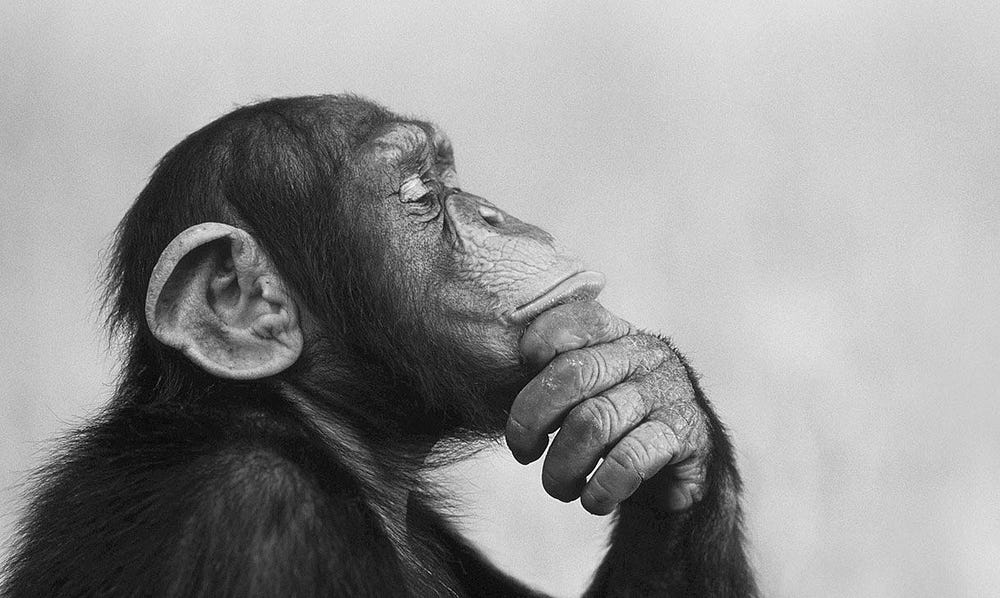
From Darwin's The Descent of Man:
"The difference in mind between man and the higher animals, great as it is, certainly is one of degree and not of kind."
According to some, one of the defining features of being human is our ability to access second-order knowledge: not just holding a belief, but holding a belief about a belief. In other words, we can question the truthfulness of our own thoughts.
Except that this is not uniquely human.
An animal may react fearfully to a stuffed predator, then, upon closer inspection, revise its assessment and conclude that it poses no danger. This kind of metacognition, or knowledge about knowledge, has been observed and documented in dogs, cats, apes, cetaceans, birds, fish, and many other animals.
The history of ethology has been, in many ways, a steady dismantling of human exceptionalism. One after another, the traits we once claimed as uniquely ours, tool use, culture, language, planning, teaching, self-recognition, empathy, and metacognition have been found elsewhere in the living world.
What remains is not evidence that humans are superior to the estimated 8.7 million other species with whom we share this planet. We are different, certainly, but not uniquely so.
With each new discovery, it becomes harder to justify the way humans view and treat the rest of the web of life.
Actively resisting the evidence and denying other species the right to live for purposes unrelated to our survival may be among the few distinctly human traits.
