My Favorite Ecosophy & Ecology Links

Sunday, August 9, 2026

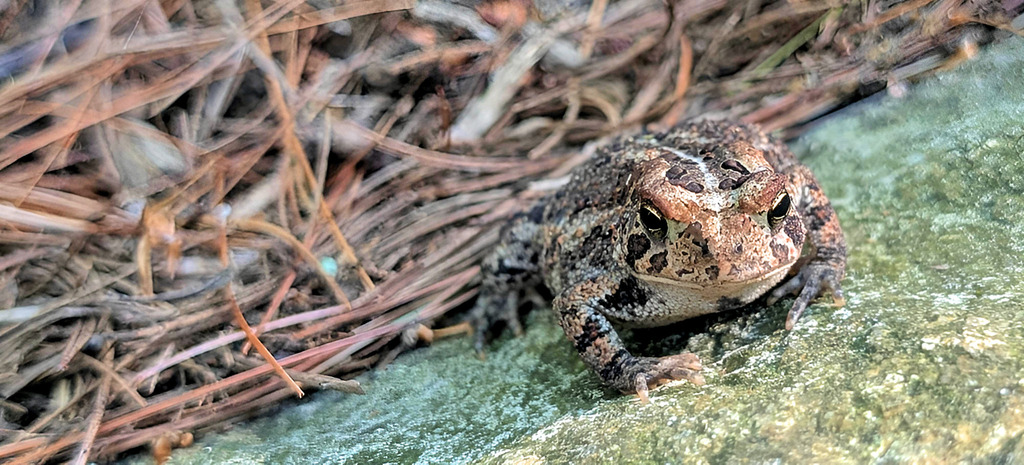
A Toad in the Leaf Litter 𓆏

Small, Hidden Continuities of August

I love catching sight of a young American toad on the forest floor. It feels like a small victory. They are superbly camouflaged among leaves, soil, and moss, so finding one is never guaranteed. It is also a quiet reassurance that some things are right in the world: young toads are where they should be, doing what they should be doing at this time of year.

By early August, many young American toads have already been on land for weeks. Having left their breeding waters from mid-June onward, they move through surrounding uplands, growing rapidly, hunting small prey, and seeking cool, moist shelter. Their diet includes ants, beetles, flies, and other invertebrates small enough to manage.

My encounters also seem to reflect the landscape. In Middlesex County, I most often see American toads (Anaxyrus americanus), while on the sandy Outer Cape, I more often see Fowler’s toads (A. fowleri). Both species occur on Cape Cod and broadly across Massachusetts, so this is an observation about local habitat and encounter patterns, not a hard boundary. Fowler’s toads are associated with sandy areas near wetlands; American toads are commonly found on forest floors and in other more mesic settings.

The forest floor is not an easy place for a small toad. Young toads face snakes, birds, and mammals, as well as hazards from road crossings, habitat loss, pollution, and disease. Their defensive skin secretions may deter some predators, but camouflage, stillness, and the availability of moist cover remain essential.

So when I catch that slight movement in the leaf litter and realize it is a young toad, I feel grateful for the small, hidden continuities of August.

🔎︎ More about American toads

→ Powell, Robert, Roger Conant, and Joseph T. Collins. Peterson Field Guide to Reptiles and Amphibians of Eastern and Central North America. 4th ed. Houghton Mifflin Harcourt, 2016.

 Raithel, Christopher J. Amphibians of Rhode Island. Rhode Island Division of Fish and Wildlife, 2019.

Wells, Kentwood D. The Ecology and Behavior of Amphibians. University of Chicago Press, 2007. 

📷 American Toad · Crapaud d'Amérique (Anaxyrus americanus) | © Claire O'Neill, please credit accordingly.

Thursday, August 6, 2026

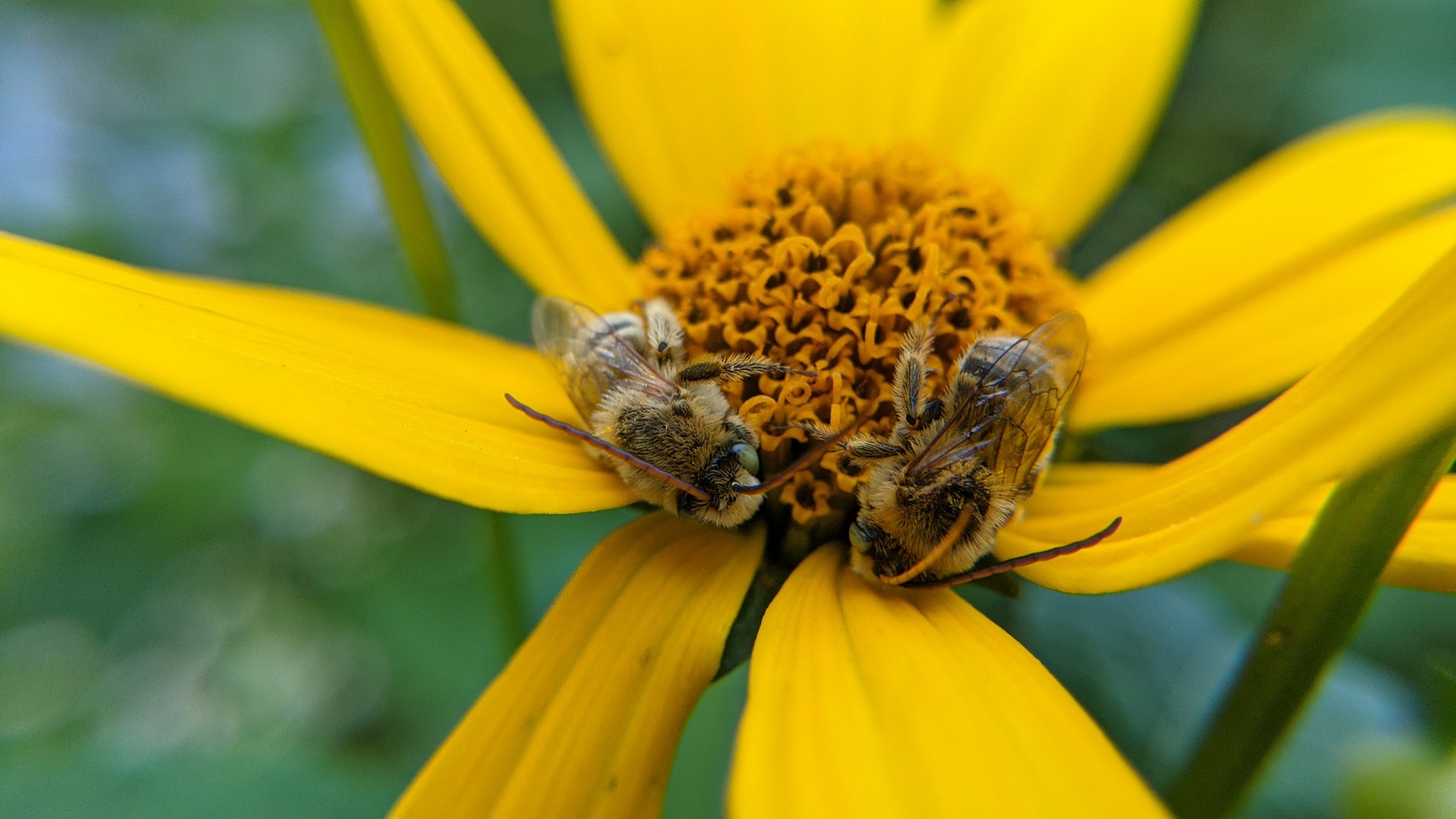
Bachelor Sleepovers in a False Sunflower 🌻

Two Long‑horned Bees and Their Shared Flower Bed

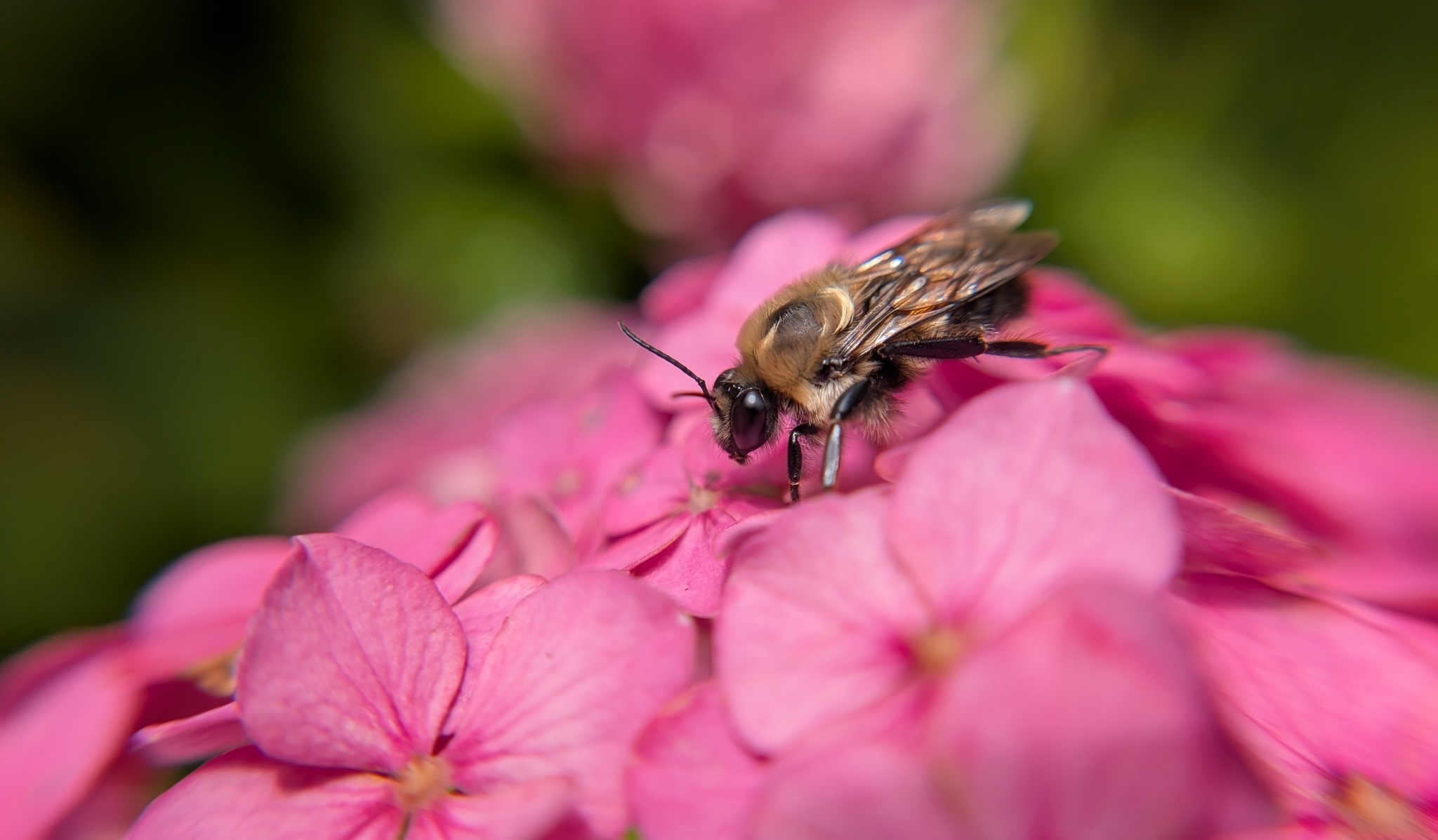
Yesterday evening, during my nightly round of the garden, I stopped to check a false sunflower where I had spotted two long‑horned bees (of the genus Melissodes) that morning, both likely males. To my surprise, there they were again, this time sleeping head to head right at the interface between the central disk and the ray flowers, rather than at a small distance from one another as they had been the night before.  

Wedged there securely, they were gently sheltered from wind and weather by the surrounding petals and by the low position of this particular flower beneath the taller blooms around it. It is a quietly touching little sleep arrangement. Male long‑horned bees often spend the night out on vegetation or in flowers like this, because they do not have nests of their own to return to. Females, in contrast, usually sleep inside the underground nests they have dug, where they are also storing pollen for their larvae.  

It makes sense that these males sleep close to the patch of flowers they patrol and use during the day. By bedding down right in their foraging patch, they minimize energy spent searching for food the next morning, and they “know” their way back into this familiar matrix of blooms. These small bachelor sleepovers on flowers are a characteristic part of male long‑horned bee life, a small but beautiful detail in their natural history. 

I am now officially committed to stalking them, or rather checking on them evening and morning, to see how faithfully they return to this same flower and how their sleeping arrangements change over time. And so I did. This morning they were still there, sleeping longer than I do. At some point in the night, they had shifted slightly apart, a tiny rearrangement in their shared flower bed. I am smitten.

🔎︎ More about long-horned bees 

→ Vermont Atlas of Life, Long‑horned Bees (Melissodes) https://val.vtecostudies.org/projects/vtbees/melissodes 

📷 Melissodes | © Claire O'Neill, please credit accordingly. 

Sunday, August 2, 2026

One Life - Fifteen New Beginnings 🦟

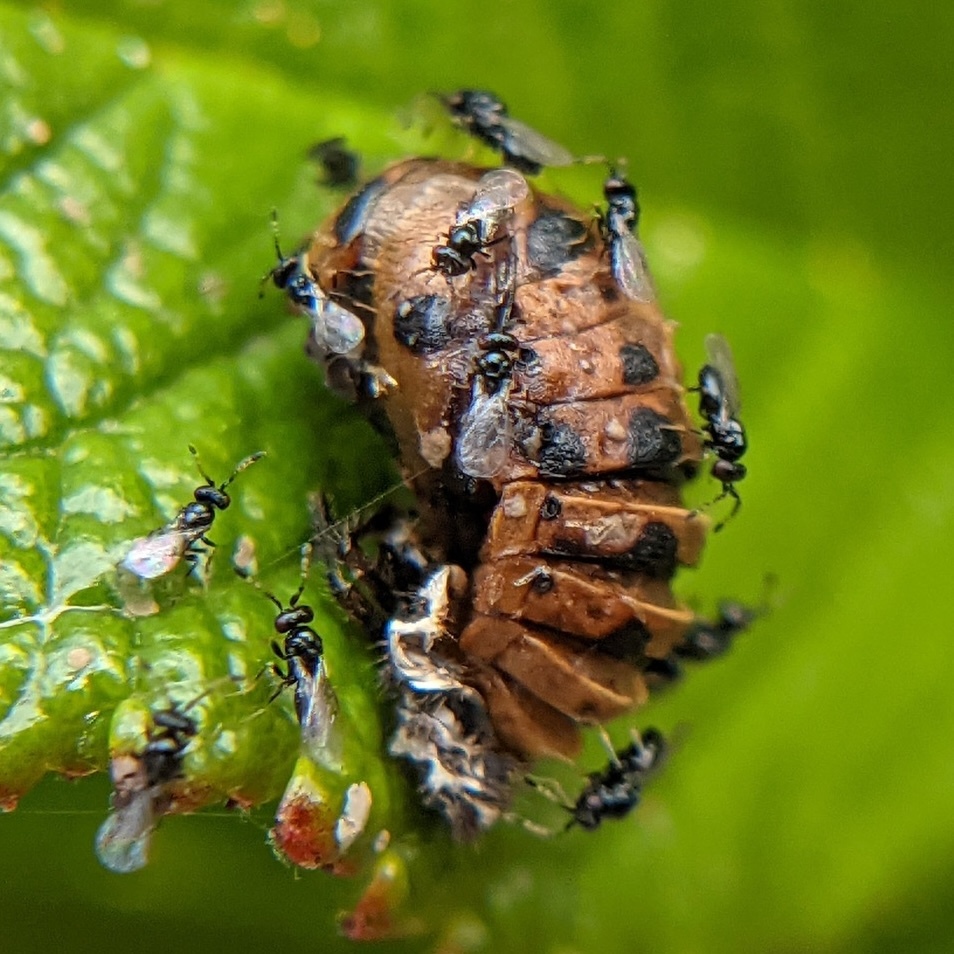
At first glance, it looked like a little piece of debris. As I approached, I realized it was a beetle pupa attached to the top of a rugosa rose leaf. 

On closer inspection, I noticed some fifteen tiny parasitoid wasps, likely chalcidoids and perhaps members of the Tetrastichinae subfamily, moving deliberately over its surface. Each was only a few millimeters long, yet together they transformed what seemed like an old, dried pupa into another fascinating natural history moment.

If these wasps had just emerged from the pupa, instead of a single beetle completing its transformation, an entire brood would have begun theirs. One host had become the nursery for these minute wasps, a reminder of the intricate ecological relationships that quietly shape insect populations.

These tiny wasps are more than a curiosity. As parasitoids, their larvae develop by feeding on a single host and ultimately killing it, helping regulate herbivorous insect populations and serving as quiet biocontrol allies in gardens, fields, and wild plant communities.

It is easy to walk past little details without a second glance. But slowing down and looking closely revealed not a piece of debris, not one insect, but some fifteen, each beginning its own story.

🔎︎ More about parasitoid wasps

→ Beneficial insects - parasitoid wasps https://extension.umn.edu/beneficial-insects/parasitoid-wasps 

→ North American genera of Tetrastichinae (Hymenoptera: Eulophidae) https://doi.org/10.1080/00222939400770091.

📷 Subfamily Tetrastichinae | © Claire O'Neill, please credit accordingly. 

Saturday, August 1, 2026

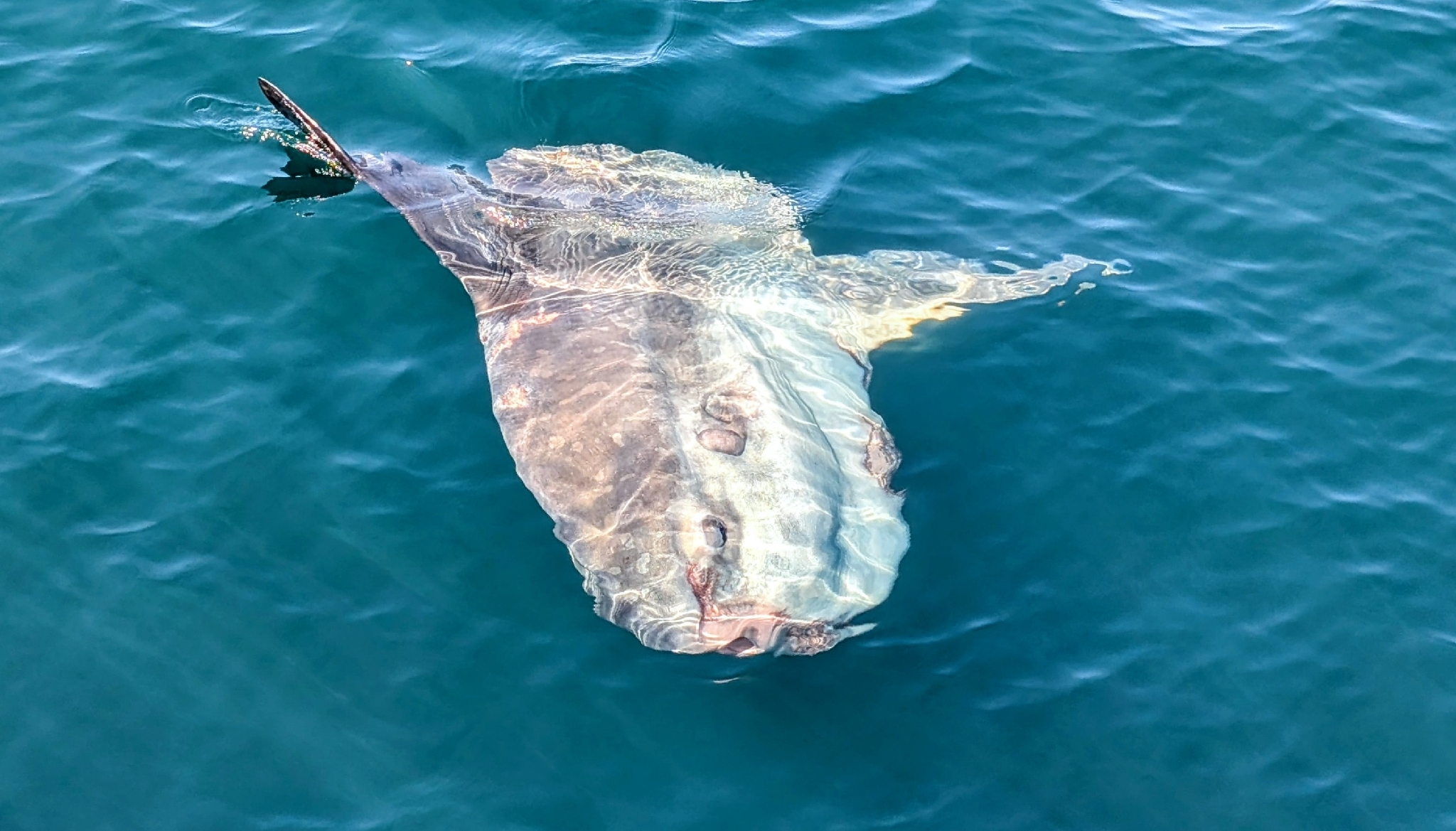
First Mola Mola Encounter, Oh My! 𓆝


Oh my God, what a treat! My first wild mola mola! What a fantastic fish!!! And not just one, but three! A truly grand day, made even more special by watching a group of nine or so humpbacks and a gray seal at Stellwagen Bank.

What an awesome, wonderfully strange fish: such an unusual shape, yet the largest of all bony fishes. I knew mola mola drift, but do they actually swim? I had to check.

Despite their awkward appearance, mola mola are surprisingly efficient swimmers and active foragers. During summer, they enter Stellwagen Bank in search of prey, including jellyfish, salps, squid, and small fish. They may not be fast swimmers, but they can travel long distances and make impressive dives. They move through the water using their enormous dorsal and anal fins, a remarkable adaptation for such an extraordinary fish.

Nature never stops surprising me and rewarding my curiosity. 💚 

📷 Common Mola · Mouldouz · Poisson-Lune (Mola mola) | © Claire O'Neill, please credit accordingly

Friday, July 31, 2026

🌳 Writing on Trees: The Hidden Life of Paper

“Following my notebook backward, from the desk to the forest and rivers that made it possible.”

I just finished a notebook. A life jotter, really.

It always takes me forever to cover the last pages. I am not sure why. The final page fills most slowly of all. Maybe I am lingering, holding on a little longer before turning a new leaf. I like writing, and handwriting especially. It feels almost like a lost art, but also like a way of thinking that keeps pace with the body. There is something meditative about pen on paper: the soft drag of ink, the quiet rustle of a page turning, the way thoughts arrive at walking speed instead of highway speed.

I am lingering again. Anyway, when I put my pen down and closed the cover, I did what I always do. I reached for the next notebook from my stack, ready to keep following the thread that has been occupying my mind lately: tree stories. New leaves of paper, new room for observations, questions, and realizations.

I placed my hand on the cover, feeling that sense of beginning, ready to give this notebook a name. Then I stopped.

Oh. I have a piece of a tree in my hand!

I am not entirely sure what I felt in that moment. Something like reverence, mixed with a rush of questions about cost and transformation. So I went looking for answers.

I have spent years tracing the lives of insects and plants, following caterpillars from leaf to chrysalis, watching leaf‑out dates slide earlier on the calendar, listening for the first spring peepers in cold, muddy pools, puddles, and ponds. It then felt strange to realize I had never traced the life of a notebook.

Of course, I know paper comes from trees. But I had never really asked how much of a tree disappears into these clean, anonymous pages.

Somewhere, a tree grew long enough and straight enough to be worth cutting. It stood through years of weather I will never see: snow packed into the forks of its branches, summer storms shaking its crown, chickadees and nuthatches and downy woodpeckers working its bark. At some point, it met a saw. Its trunk became logs. The logs became chips. The chips became pulp, a pale, frothy slurry that bears almost no resemblance to its former forest. From there, it was pressed, treated, dried, sliced, and packaged until it arrived here, in my hand, as this quiet, compliant thing we call a notebook.

How many sheets of paper does one tree become? How many jotters? How many books?

The answer depends on species, size, and processing, but a single straight pine or spruce can yield on the order of ten thousand sheets of standard paper. My notebook, with roughly one hundred fifty sheets, represents about one‑sixtieth of a tree. A classroom of students, moving through notebooks and loose‑leaf paper over a year, could quietly disperse several trees into homework, handouts, and margins filled with notes and drawings.

Thinking this way does not make me want to stop using paper. I value the slowness of handwriting too much, its way of inviting attention instead of speed. But it does change how I begin. Each new notebook asks for a moment of awareness, a small acknowledgment, and a quiet thank you. Some part of a once‑living trunk has been thinned into these pale, flexible pages so that I can write the lives of other beings. Beginning there shifts the page from something I use to something I am in relationship with.

The tree itself is only the beginning of the story. Follow paper from forest to finished product, and the notebook on my desk carries more than wood fiber. It carries histories of energy, water, and waste.

Researchers who study the life cycle of paper trace each stage: harvesting, transport, pulping, bleaching, pressing, drying, cutting, shipping. At every step, they measure energy use, water consumption, and emissions. Taken together, their work shows that paper is an energy‑intensive material. Mills run on heat and electricity. Logs travel long distances. Machines operate continuously. The invisible flow of energy behind this notebook far exceeds the small effort it takes to lift it.

Then there is water. Pulp and paper mills draw deeply from rivers and aquifers and return much of that water altered, darkened by organic matter, warmed, or carrying processing chemicals. Studies of mill effluent have documented high loads of organic material and measurable effects on fish, invertebrates, and microbial communities downstream. In some systems, mill discharge has been a dominant influence on water quality. The notebook feels clean and dry on my desk, but its making may have left traces in moving water, in the chemistry of a river, in the physiology of the organisms that live there.

None of this means all paper is equally harmful, or that the industry is static. The same research that documents impacts also points toward ways to reduce them: improving energy efficiency, shifting away from fossil fuels, increasing recycled fiber, and strengthening wastewater treatment. Using recycled paper can lower certain environmental burdens, including energy use and some forms of pollution. But there is still a cost. Recognizing that cost does not require abstaining from paper; it asks for attention, restraint, and respect for each page, and for the tree that made it possible.

That awareness changes small choices. I reach for recycled notebooks when I can. I print double‑sided. I ask questions about sourcing when the opportunity arises. These are light actions, but they are not nothing. They are ways of participating in a system that is still being shaped.

I share this not to provoke guilt, but to make something visible. Paper is how we think, teach, and remember. It is also how we touch forests and rivers, often without realizing it.

There are simple ways to act on that awareness: choosing paper with recycled or responsibly sourced fiber, printing only when needed and using both sides of a page, supporting companies and policies that invest in cleaner production. I no longer carry paper into the field. Years ago, I shifted to recording observations digitally. It reduces my use of paper, but just as importantly, it creates better science. The observations are immediately shareable, easier to verify, and become part of long-term ecological records rather than remaining on pages that must later be transcribed.

But beyond these choices, there is also a relationship. Each page is a thin cross‑section of living systems: a fraction of a tree, a measure of energy and water, a moment in a river’s story. When we write on it, we have the chance to make that relationship matter, by paying attention, by documenting phenology, by telling stories that help keep forests standing.

So I open this new notebook knowing it holds both comfort and cost. I name it for the trees and all the beings who depend on them, myself included, and for the tree whose fibers form its pages. I begin with a small thank you, and then I begin writing, hoping the words I place here will be worthy of the forest that made them possible.


A Naturalist's Note

Every object has a natural history.

We tend to reserve that phrase for birds, trees, insects, and wildflowers. But the things we make also have lives that begin long before they reach us.

A notebook begins in a forest, travels through rivers, mills, machines, and human hands, and eventually arrives at a desk, where it quietly waits to become someone’s thoughts.

The next time you finish a notebook, pause before opening another.

Hold it for a moment.

Ask where it came from.

Ask what it cost.

Then make the words you write inside worthy of the life that made them possible.


Further Reading

For readers who want to follow this thread into the technical literature, here are a few starting points:

Uncovering energy use, carbon emissions and environmental burdens of pulp and paper industry: A systematic review and meta-analysis.
Renewable and Sustainable Energy Reviews, 2018.
Synthesizes global data on energy use, greenhouse gas emissions, and other environmental burdens in pulp and paper, identifying major process hotspots and options to reduce impacts.


Decarbonizing the pulp and paper industry: A critical and systematic review of sociotechnical developments and policy options.
Published 2022.
Reviews hundreds of studies to examine how the pulp and paper industry, which uses about 6% of global industrial energy and causes around 2% of direct industrial CO₂ emissions, can reduce its climate impacts through technologies, policies, and broader system changes.

Estimating the climate impacts of future paper production and recycling with life cycle assessment.
Science of the Total Environment, 2026 (online ahead of print).
Uses prospective life‑cycle assessment to model climate impacts of virgin and recycled paper and cardboard in Europe through 2050, showing how decarbonizing energy systems changes total paper‑related emissions and the climate benefits of recycling over time.

Global paper market forecasts to 2030 under future internet demand scenarios.
Study using scenario analysis (date earlier, but forward‑looking).
Scenario analysis of world paper demand under varying levels of digital information use, highlighting declines in some grades (such as newsprint) and shifts toward packaging and specialty papers.
Sunday, July 26, 2026

𓆦 A Bright Fly in Summer Gold

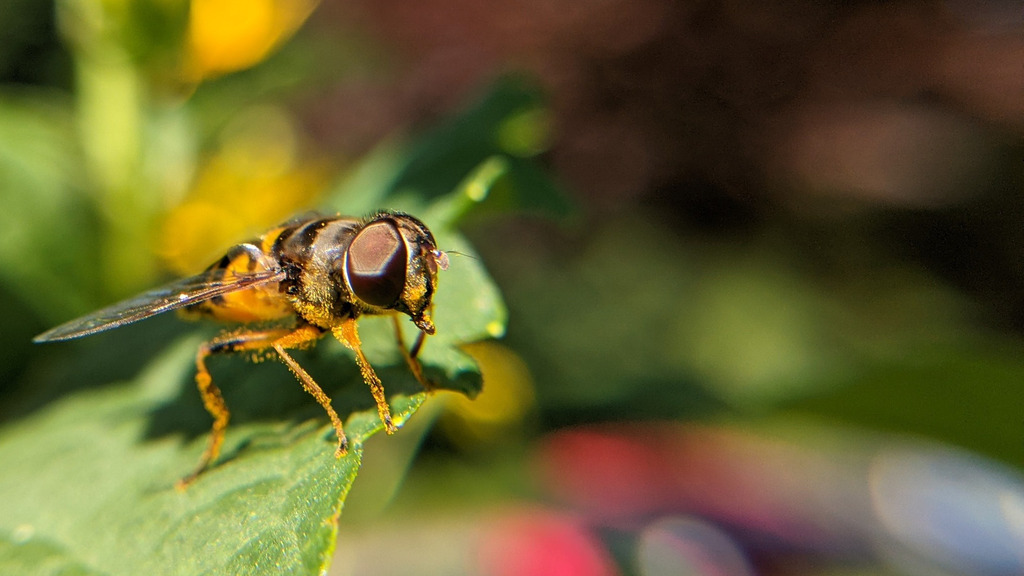
A little garden note for July: The transverse-banded flower fly (Eristalis transversa) was working over my false sunflower (Heliopsis helianthoides) today, dusted with pollen and moving from bloom to bloom with that purposeful, unhurried flower fly rhythm. I see them regularly in the area, in meadows, gardens, and flower pots, and I always appreciate this brightly colored bee mimic reminding me that flies are doing important ecological work even when they’re easy to overlook. This one was a small but steady pollinator, and a good example of how much life a summer flower can hold if you pause long enough to notice. They may not get the affection they deserve, but they are absolutely part of the garden’s story.

📷 Transverse-banded Flower Fly · Syrphe à Collier (Eristalis transversa) | © Claire O'Neill, please credit accordingly

Thursday, July 16, 2026

A Handful of Observations, A World of Stories

A handful of observations from three days in the Outer Cape.

Every walk is an invitation to slow down and notice. A meadowhawk (Sympetrum sp.) paused on common soapwort (Saponaria officinalis). Nearby, black cherry (Prunus serotina) leaves bore the distinctive pouch galls of the black cherry leaf gall mite (Eriophyes cerasicrumena), while gray birch (Betula populifolia) was already fruiting, its immature seed cones promising the next generation of wind dispersed seeds. A scarlet argid sawfly (Arge coccinea) rested on staghorn sumac (Rhus typhina). An eastern teaberry (Gaultheria procumbens) flower, viewed from below, revealed the delicate five pointed star hidden within its white corolla. Finally, beneath the cap of a brittlegill mushroom (Russula sp.), two common rough woodlice (Porcellio scaber) shared shelter with a "one-legged" cricket, possibly a sphagnum ground cricket (Neonemobius palustris).

None of these observations is especially rare. Yet together they tell the story of a landscape that rewards careful attention. Natural history is not only about finding the extraordinary. It is about learning to see the extraordinary richness hidden within the ordinary.

📸 All my visual observations these past three days on the Outer Cape  here | © Claire O'Neill, please credit accordingly.

Monday, July 13, 2026

Volume and Line: Two Architectures of Life

I love that social media casually asks, "What's on your mind?" It gives me an excuse to answer with things like this:

Right now, I am thinking about the shape of life. More precisely, I am thinking about the fascinating way plants grow. Unlike animals, whose bodies are organized as volumes that grow by expanding an established form, plants grow primarily through linear extension. They continually add new roots, stems, branches, and leaves, reshaping themselves throughout their lives.

Imagine how extraordinarily complex that architecture must become to maximize the capture of light, the exchange of gases with the atmosphere, and the uptake of water and nutrients from the soil.

Yes, this is genuinely the kind of thing that's on my mind.

Tuesday, July 7, 2026

꩜ The Long Return to Breizh

On names, belonging, and cultural return

How close am I to my Breizh culture, a friend once asked.

It feels like a complicated story for those of us who live far from the land that shaped us, especially when that culture has survived only in fragments, still trying to re-emerge, and the language itself is thinning, harder to reach, as if it asks for a different kind of listening.

I feel it close at heart. Not as possession, but as a pulse, something ancient that continues to move beneath distance. Yet I remain at the beginning of a return, a cultural réappropriation still taking shape.

To begin, I honor a Breton name given to me some time ago: Enora.

My civil name is Claire. Enora came later. When I asked a Breton connoisseur who I would be in Breton, his answer was immediate: Enora. The choice was not linguistic but personal. He did not choose it as a translation of my name, but because he felt it reflected my temperament, my values, my way of being. Over time, I came to understand why.

Associated with the Breton word enor, honour, and borne by a sixth-century Breton saint, Enora is a name rooted in the landscape, memory, and traditions of Breizh itself.

I like to think it points toward a way of being grounded in care rather than performance. My advocacy, science, ethics, and language are attention, not display. I try to hold meaning and naming carefully, resisting the quiet flattening through which things lose their weight and harm becomes harder to see.

In that sense, honour is not elevation. It is fidelity: fidelity to what is true, to what is owed, and to the relationships that bind us to one another, to place, and to time.

Enora is short, distinctly Breton, Brythonic rather than Gaelic, feminine without ornament. It carries a quiet austerity, as if language itself had been pared back to what cannot be taken away. A name that feels less like an inheritance than an invitation. Less like a claim than a direction.

Claire is who I am in daily life. Enora is who I am reaching toward. I hold them both, not as a contradiction but as two ends of the same thread, one given at birth, one offered as an invitation. Belonging, I'm learning, is not always something we receive. Sometimes it is something we grow into. And sometimes the journey begins with a name that asks us to become worthy of it.

Friday, July 3, 2026

A Racer Bolting Through the Leaves 𓆙

Today I encountered my first Northern Black Racer (Coluber constrictor) in the Beech Forest in Provincetown, a human-wildlife disturbance event from the snake’s perspective, no doubt. I decided she was a she because that was how she felt to me, though I know there is no easy way to tell in the field. She produced a short, dry rattling sound, likely from tail vibration in the leaf litter, just long enough for me to localize and identify her before she bolted. Because she did bolt, and this caught me by surprise, I even jumped back a little, despite already keeping a good distance from her. She seemed to rely on speed rather than crypsis or any prolonged defensive display. She half-flew and slithered. Her escape response was immediate, powerful, and intimidating.

Witnessing that acceleration and directional control was a privilege and hinted at how well adapted racers are for active, diurnal foraging in open or semi-open habitats. In a beech forest, where fallen leaves and shifting light can offer some concealment, that kind of movement still seemed to matter most: quick reaction, alertness, and the ability to turn a sudden disturbance into distance.

📷 North American Racer · Couleuvre Agile (Coluber constrictor) | © Claire O'Neill, please credit accordingly. 

Thursday, July 2, 2026

🕸️ A Star in the Salt Marsh: The Orbweaver of Hatches Harbor

Walking back along the Hatches Harbor main trail, I wasn’t looking for a spider. I was mostly looking for a way out of the heat. At this stretch, the path runs between salt marsh and tidal flats, harshly lit, the kind of midday glare that flattens everything into high-contrast shapes. I let my eyes do what they usually do in the field, scanning for what might be out of place, for the small break in pattern that says something living is tucked into the scene.

That was when I noticed the blotch.

Halfway up a great mullein stalk, a darker, spiky knot interrupted the clean, pale stem. I first mistook it for an unopened spotted knapweed flower head, something plant-like enough to pass by. Only then did it resolve into a remarkable little spider, a starbellied orbweaver, clinging to the stalk and nearly merged with the mullein’s woolly surface. From a distance it read as plant. Up close, it became pattern.

The starbellied orbweaver (Acanthepeira stellata) is a spiny-abdomen orbweaving spider found across much of North America. It favors open, sunny habitats, where it spins vertical webs at night to intercept flying insects. Its camouflage is especially effective against stems and dried vegetation, making it well suited to exposed coastal landscapes. Like other orbweavers, it builds the familiar wheel-shaped web, though in the glare and heat of the trail hers was difficult to see and may have been partly damaged. She seemed almost part of the mullein, a small, still shape holding fast in full sun.

At first I saw only her body and the plant. She was alert yet relaxed. No obvious web cut the space around her. The air beside the stem looked empty, full of heat shimmer and insect flight but not silk. Only after I stood quietly for a while did the rest of her story emerge: a faint suggestion of threads lower down the stalk, near the leaves, where the plant’s architecture thickened. There, the web was less a perfect wheel than a blur of lines tucked into the cooler, more textured part of the plant.

The spider had chosen the blotch position, above the main web, exactly where my brain would almost, but not quite, file her away as part of the plant. What broke the illusion was the thing I rely on most in the field: the sense that the symmetry is just a little off, that one small patch of color or shape doesn’t quite belong.

I do not see this species often. In fact, this was only my second sighting, and strangely enough, the first was exactly one year earlier to the day, on the same trail! Some places seem to keep their own calendars.

📷 Starbellied Orbweaver (Acanthepeira stellata) | © Claire O'Neill, please credit accordingly. 

▫ ▫ ▫

Aside: why “broken symmetry” works

When you walk through a habitat, most of what you see is repeating structure: stems rising at similar angles, leaves arranged in familiar patterns, stones with consistent colors and textures. Your visual system is excellent at compressing all that into “background” so your brain doesn’t have to process every leaf individually.

Insects and spiders often survive by disguising themselves as part of that background, mimicking thorns, bark, dead leaves, or seeds, but the mimicry is almost never perfect. There’s usually some small mismatch in color, outline, texture, or orientation: a triangle where everything else is linear, a matte patch on something glossy, a curve where the plant world is mostly straight. When you train yourself to look for those tiny disagreements, you start to pull animals out of camouflage that most people walk straight past.

A simple practice: on your next walk, consciously soften your gaze and scan for “the one thing that doesn’t quite fit,” a strangely shaped knot on a twig, an extra bump on a stem, a shadow that seems too crisp. Pause and give that oddity a few extra seconds of attention. Even if nine times out of ten it’s just plant tissue or debris, the tenth time it resolves into a spider, a leafhopper, or a tucked-in moth, and your pattern-spotting gets better with every success.

Wednesday, July 1, 2026

On Speaking to a Room I Cannot See

Recently, I gave a virtual talk where the participants were not visible at all: no faces, no names, just my host and me, and a counter at the bottom of the screen. The experience crystallized something I have felt for a while: I am not at home in this format.

Webinars are often designed for scale and control. Everyone is muted, some formats now impose that cameras are off, and interaction is funneled into narrow channels, usually a chat box or Q&A window (as was the case here, and it caught me by surprise). From a host’s perspective, this can make sense in some situations. It prevents interruptions, protects privacy, and keeps the program running on time. But for a speaker whose core values are exchange and conversation (which was the stated objective of this talk), it removes the very cues that make communication feel alive. Without that basic human visibility, it is impossible to read the room, adjust to people’s needs, or feel that the exchange is mutual rather than transactional.

Seeing people is not a luxury; it is part of what makes communication respectful. People’s choice to keep their video off is entirely their own, and I respect that. What matters to me is that participants are at least given the option to be visible, rather than being structurally kept invisible by the format. Equally, when it is possible, I need to be able to see some of the audience. An organization’s decision about format (as in this case, my host’s organization rather than the host herself) should not make both speakers and attendees hostage to enforced invisibility.

When an event chooses a setup that hides the audience while asking the speaker to show up fully, it creates an imbalance. The speaker’s presence is exposed and accountable, while the audience’s presence is abstract and anonymous. That design choice says something about whose experience is being prioritized and whose experience is being dismissed.

Going forward, I am going to be more deliberate. Before accepting an online speaking invitation, I will ask how the event is structured. If it is a strict webinar, I may request a meeting format, or at least some way to see and hear participants during part of the session. And if that is not possible, I may choose to decline.

I do not mind technology; it is part of my background. But I mind how respectfully we use it. I mind being asked to show up fully for people who are structurally kept invisible. Respect in communication includes the simple courtesy of letting us see each other. This is not about rejecting technology. It is about insisting that, even online, we treat knowledge-sharing as a relationship rather than a broadcast.

Thursday, June 25, 2026

Lives Interlaced on a Black Cherry Leaf 🐜

I had set out with a simple plan: check a bog and maybe catch sight of pitcher plants. These days, it is never a given, as many bogs are quietly drying. When I couldn’t find a place to park, I turned back, stopped the car, looked at a trail map, noticed a cluster of nearby paths, and thought, ‘I haven’t been there’, and decided to see what it holds.

That small shift led me into a mixed pitch pine, black oak, and scrub oak maritime forest. The trail opened toward an overlook of kettle ponds and parabolic dunes, their forms shaped by a steady wind moving in one direction. Simply lovely.

As usual, covering less than a mile took me a long while. Color, texture, and form in the vegetation kept asking for attention.

With pitcher plants out of the picture in this habitat, I returned to my other thread of inquiry this week: following the movements of carpenter ants and their relatives along vegetation. A black cherry caught my eye, though not at first for itself. What revealed it were the black cherry leaf gall mites (Eriophyes cerasicrumena). Lately, it is often the tracks that introduce me to the host. Tracks have become my first keys. I have grown to appreciate this way of seeing. It echoes what I often share on walks: interactions are what make worlds. What an organism is in isolation is less than what it is within its community.

I lingered on the leaves, watching the galls shift in color from cream to a deep dusty rose. Ants moved deliberately among them. When I gently touched the twig holding those inhabited leaves, the ants responded immediately, quick and purposeful in their defense.

Looking more closely, I realized that the deeper pink or mauve forms I had been noticing were not galls at all, but caterpillars.

Using a twig to keep a respectful distance, I parted the leaves slightly. The caterpillars appeared to be feeding on the gall tissue, perhaps on the tiny inhabitants of those galls. In return, I assume the caterpillars offer the ants a sugary secretion, which would keep the ants nearby and give the caterpillars a kind of protection. The black cherry provides the site and food altered by the gall mites, the mites create the nutrient-rich structures, the caterpillars exploit those structures and their occupants, and the ants patrol and defend the spot in exchange for the sweet reward. Four species, tree, mites, caterpillars, and ants, together form a small living economy of shelter, food, and defense.

Yet as I watched, another question emerged: what is the black cherry getting from all of this?

I have since logged the observations and am waiting for confirmation. Whether or not the identification holds, the moment stands on its own. It was a reminder that attention shapes what we find. Plans may guide us to a place, but it is the openness of mind and senses that reveals what is already there.

📷 Cherry Gall Azure · Azur des Phytoptes du Cerisier (Celastrina serotina) | © Claire O'Neill, please credit accordingly. 

Friday, June 19, 2026

🌸 A Hole in the Flower


While surveying late spring wildflowers recently, I paused to admire a flowering rock harlequin. At first glance, the bloom appeared unremarkable. But a closer look revealed something unexpected: a perfectly round opening near the base of one of its nectar spurs.

The flower itself was intact. The petals were fresh, the spur undamaged except for this small circular hole, as though someone had carefully punched a tiny doorway through the side.

Who made it?

The question is not easy to answer. A flower can tell a story, but it does not always reveal all of its characters.

Some insects obtain nectar by entering a flower through its natural opening and, in the process, may transfer pollen between plants. Others bypass the usual route and access nectar through openings in the side of a flower. Sometimes these openings are created by insects themselves. Sometimes they may already exist. Distinguishing among these possibilities often requires repeated observation and a bit of detective work.

What fascinated me most was not solving the mystery immediately, but noticing it in the first place.

Moments like these remind us that ecology is not only about collecting data. It is also about cultivating attention. A tiny hole in a flower can open a window onto questions of plant anatomy, insect behavior, species interactions, and the countless ecological relationships unfolding around us every day.

Many of the observations collected through EwA's field studies begin this way: with curiosity. A detail catches our attention. We ask questions. We return. We observe again. Over time, individual observations accumulate into a richer understanding of the living systems we share.

Nature rarely reveals all of its stories at once. Sometimes it offers only a clue and invites us to look closer.

📷 A rock harlequin flower displaying a small circular opening near the base of its nectar spur. Observations like this often spark new questions about species interactions and ecological relationships. Observed on June 1st, 2026 and recorded here | © Claire O'Neill, please credit accordingly.

Thursday, June 18, 2026

≽༏≼ A Lady Eastern Pondhawk at Close Range

She seemed determined to land on my hand. Every time I moved it, she followed, so eventually I gave in and waited patiently until she decided she was done with me. It took a while!


The Importance of Place

Female Eastern Pondhawks seem to pick up on the territory first. A floating mat of plants matters because that’s where a male is set up, and where mating and egg-laying can actually happen. So in a way, the female is choosing a defended patch with a male already holding it, not just picking a mate out in the open.

What seems to matter most is the quality of the site, how well the male holds it, and whether the patch is worth guarding. A good little raft of vegetation probably means both a solid male and a good place for eggs.

In short, the floating plant mat is doing more than just floating there. It’s part of the whole mating setup.

📷 Eastern Pondhawk · Érythème des Étangs (Erythemis simplicicollis) | © Claire O'Neill, please credit accordingly. 

Wednesday, June 17, 2026

Threaded Things

On my way to Ptown, binoculars in one hand, checking the surf just in case, my head wrapped in the harmonies of Abel Korzeniowski, I am catching up on some reading about termite societies. Then I remembered: termites have not only a queen but also a living king. They pair for life and spend their entire reign together in the royal chamber.    

In my mind appeared a busy colony, underground or hidden deep within a mound, its different castes working together to sustain the whole. Then, as the violin crescendoed, the little king suddenly stepped into the foreground of my imagination. That image made me smile. And then, unexpectedly, it made me tear up.

Go figure.
--- 
📷 Not a king or queen, but just as captivating, likely a worker caste individual, possibly the Eastern subterranean termite · Termite à pattes jaunes (Reticulitermes flavipes) | © Claire O'Neill, observed Apr 25, 2020 · Medford, MA, USA

Monday, June 15, 2026

To the Women the Land Knows


As I approach my sixties, I find myself reflecting on a life lived as a woman in fields long dominated by men. For decades, I led in technology while, in parallel, cultivating another life rooted in learning from the natural world. Eventually, I left a corporate environment that clashed with my values and too often failed to recognize the contributions of women, and stepped more fully into the work that had been calling me all along.

Today, I am a woman naturalist with French and Breizh roots, spending nearly every day in the field, learning from the land, and sharing what years of attention have taught me.

I came to natural history through decades of attention. I was always a nature explorer in the truest sense of the word, not to conquer, not to collect trophies, but to be in relation. The formal naturalist work came later. The knowing had been accumulating all along.
  
The naturalist world is no different from many others. Women continue to navigate patterns of erasure and exclusion that are often subtle, yet deeply entrenched.

That experience is not mine alone. There has been some progress, and I can see it in the work of women who have reshaped parts of this field from within. Look at the legacy of primatologist Jane Goodall, the work of forest ecologist Suzanne Simard, and many others who have been steadily shifting what counts as knowledge and who gets to produce it.

But in everyday community life, the imbalance remains. Subtly yet persistently, women naturalists are still overlooked. We lead the walk, and someone else gets the microphone. We build the knowledge base, and someone else publishes the interpretation. We have been doing this work, patient, relational, reciprocal, for as long as there has been ground to tend and seasons to read. And still we are asked to justify our presence in the land we never left.

In our field, perhaps more than ever, the collectors of names are celebrated over the keepers of relationships, those who connect species to place, season, memory, and community. That too is a form of erasure.

We are keepers of time. We read the season before the calendar catches up. We know the first spring ephemerals, the first wood frog call, the first insect emergence, not as data points, but as obligations, as relationships, as the texture of a world we have committed ourselves to paying attention to, a language learned through years of observation and data that deepen attention rather than define it.

We are holders of knowledge, not the extracted, transactional kind, but the kind that accumulates through return, through presence, through caring about what happens to a place across years and decades.

We are guardians of reciprocal traditions, ways of being in relation to land and life that predate the institutions that have so often failed to see us.

This is not new. It carries the long shape of erasure.

Jeanne Baret from France, the first woman to circumnavigate the globe, disguised herself as a man just to board the ship and do the work. She collected thousands of botanical specimens along the way. The flowering vine she helped bring to scientific attention was named Bougainvillea, after the expedition leader, not after her.

Beatrix Potter from the United Kingdom brought rigorous scientific attention to mycology at a time when the Linnean Society would not admit her. Her research on fungal spore germination had to be read aloud by a man because she could not present it herself. She is remembered for her illustrations of rabbits, not her scientific work.

Rachel Carson from the United States spent her life studying marine ecosystems with patience and precision, then wrote a book that shifted the course of environmental policy. The response from industry was not to engage her science, but to dismantle her credibility as a woman, as an alarmist, as someone presumed to have no authority in the natural world.

Ynes Mexía from Mexico and the United States, a Mexican American botanist and field explorer, collected more than 150,000 plant specimens across the Americas, with major work throughout Mexico and South America. Her contributions to botanical knowledge remain far less visible than the scale of her work would suggest.

And in our own time, forest ecologist Suzanne Simard from Canada, whose research reshaped how we understand forests as interconnected living systems, continues to defend and reinforce the legitimacy of that work while still navigating resistance to its full acceptance.

These are not exceptions. They are the structure, repeating across places and ecosystems. From European forests to North American coasts, from Latin American mountains to global voyages shaped by colonial expeditions, the pattern holds. Different landscapes, same pattern of recognition and erasure.

And still the women go out. Still, they crouch at the edge of the vernal pool. Still, they photograph, record, annotate, remember. Still, they teach their children, their neighbors, their communities, outside the institutions that do not invite them in.

The land does not overlook them. The moths come to those who wait. The wood frogs call on the same March nights they have always called, and there are women who have been counting those nights for twenty, thirty, forty years, without grants, without titles, without anyone handing them the microphone.

I came to this field late by some measures. Not late by mine.

I have been exploring since I can remember, crouching beside things, staying still long enough for the world to forget I was there, learning names and, more importantly, their stories, not to own what I encountered but to be in better relation with it. The phenological work, the protocols, the careful recording of first emergence and last call, all of that came with time. The attention was always there.

And so I know something about what it means to carry knowledge that institutions often dismiss, to do work that does not always come with a title, to love a field that has not always made room for you, and to use the rigor of data and long-term observation to help widen what counts as ecological understanding.

I write this for the women who are still out there at first light, in the rain, on their knees beside something small and extraordinary. Named and unnamed. Credentialed and not. The ones the poster does not feature and the ones the land has always known.

You are not the assistant on this walk.

You are the ones who know.


© 2026 Claire O'Neill. Text and photographs by the author. All photographs feature friends from the Earthwise Aware (EwA) community.

Sunday, June 14, 2026

The Return of the Carders 🐝

The Annual Reunion of a Bee, a Plant, and One Who Pays Attention

I do not keep rigorous phenology records for my little patch of lamb's ears (Stachys byzantina), though perhaps I should. Still, I pay attention.

Every year, a moment comes when the soft silver leaves send up their flowering stalks and the first flush of purple appears. I am not entirely sure whether those purple parts are petals or sepals, but the effect is always the same: as soon as I see that color, I feel a small jolt of anticipation, because I know the wool carder bees are on their way.

Not long after the flowers begin to bloom, there they are. It felt as though I waited a little longer this year, and I should probably record the interval between flowering and the bees' arrival. The lives of solitary bees are brief, and the individuals I see today are almost certainly descendants of those I watched last year, continuing a relationship that has likely persisted in this small patch for generations.

The male wool carder bee (Anthidium manicatum) is usually the first one I notice. This year, I spotted him patrolling a nearby patch of beardtongue before returning to the lamb's ears. He saw me and hovered at eye level, impossibly confident for a bee scarcely larger than a fingernail. There is something almost confrontational about the way he faces me, suspended in the air as though evaluating whether I belong in his territory.

"Hey, woman. Leave my patch and my girl alone. I am watching youI"

Male wool carder bees are famous for this behavior. Rather than defending a colony, they defend patches of flowers rich in nectar, chasing away rivals and almost anything else that enters their airspace. Few bees make their territoriality so obvious.

Soon his attention shifted to a female moving among the flowers. He rushed toward her with an enthusiasm that seemed only partly welcome, while she carried on with the business at hand. She fed among the flowers and visited the leaves, scraping their soft hairs with her mandibles. Those fibers will line the brood cells where the next generation develops, giving wool carder bees their name.

What fascinates me is that both bee and plant arrived here from elsewhere. Lamb's ears originated in western Asia. The wool carder bee evolved across Eurasia and was first recorded in North America in 1963, and has since spread widely. Yet they arrived carrying an old familiarity with one another. The female still gathers the woolly fibers. The male still patrols the flowers. Behaviors shaped long before either reached New England.

A plant and a bee, both far from their ancestral ranges, still performing behaviors shaped by a much older evolutionary history. The female gathers plant fibers. The male patrols his territory with grand confidence.

And I find myself watching. The purple appears. The carders return.

📷 European Woolcarder Bee · Anthidie à Manchettes (Anthidium manicatum) | © Claire O'Neill, please credit accordingly. | EwA Buggy observation (first seasonal record at my patch) → here

Saturday, June 13, 2026

𖡼𓆧 Watching a Katydid Return Each Year

 When Little Katy Appears: Notes from a Native Garden

Little Katy is back! Yes, I name the familiar faces in my yard. Little Katy has been a regular resident of my native garden for the past few years, though I spotted this one at the Growing Center this time. I am sure I will find her again among the plants. Seeing this little one emerge always brings a smile. I find the nymphs especially charming, and this is a fascinating species to observe over time.

This is the Mediterranean katydid, now beginning its seasonal appearance in Massachusetts, a small but increasingly familiar presence as warm months settle in. Originally native to the Mediterranean region, it has expanded its range in recent decades and now appears locally from late spring through summer, often first noticed through its soft, rhythmic calls at dusk.

In Massachusetts, sightings and acoustic detections typically increase as temperatures rise and vegetation thickens, especially in urban edges, gardens, and grassy habitats where it finds shelter and food. Its arrival is a quiet reminder of shifting ecological patterns, where climate and human-altered landscapes are reshaping which insects now share our evenings.

If you listen closely in the coming weeks, especially after sunset, you may start to notice its steady presence woven into the night chorus.

Note that in Massachusetts this species is considered an introduced, non-native species, but it is not formally classified as a regulated invasive pest.

📷 Mediterranean Katydid · Phanéroptère Méridional (Phaneroptera nana) | © Claire O'Neill, please credit accordingly.

Monday, June 8, 2026

𖡼.𖤣𖥧𖡼.𖤣𖥧 Spoonleaf Sundew: Tiny Traps, Big Wonder

I am super excited: I recorded our first spoonleaf phenology on EwA Pheno Lite! I now know a few patches of these remarkable plants in the Outer Cape, and I was especially looking to see whether they were flowering. The one patch I visited so far was not.

Even without flowers, spoonleaf sundew is already doing something remarkable. This is a small wetland plant with leaves that act like tiny sticky traps. In the photo, you can see one of those traps in action: a tiny insect is caught right on the leaf, held fast by the plant’s glistening (and sticky) glands. After capture, the leaf slowly curls inward, helping the plant digest insects and get nutrients from the poor, sandy soils where it grows.

Phenologically, this is the season when flowering is expected to begin or soon follow. In the Outer Cape, that likely means a close watch now for emerging scapes and the first blooms as summer advances. These plants are fragile, so I am always careful where I step and mindful to avoid wetland edges. I am so excited to keep following these plants from here on out.

📷 Spoonleaf Sundew · Droséra Intermédiaire (Drosera intermedia) | © Claire O'Neill, please credit accordingly. 

Monday, June 1, 2026

𓇢𓆸 A Tiny Defensive Landscape

Ha! 💚 I am mesmerized by the tiny stalked hairs with their bulbous, secretion-filled tips that make the bud surface glisten. These are glandular trichomes on the sepals and outer surfaces of the flower buds of hairy beardtongue (Penstemon digitalis) just as they are about to open. Each little "dot" is a short hair topped with a clear, rounded gland that catches the light and sometimes merges with neighboring droplets. The stalks are relatively short, while the heads are swollen and translucent, giving the buds a dewy, resinous appearance rather than the matte fuzz produced by non-glandular hairs.


I am learning that these trichomes secrete a mixture of compounds that make the bud tips tacky. At this early stage of development, the secretions may help deter small herbivores, interfere with tiny crawling insects, protect delicate tissues from drying, and modify the immediate environment surrounding the developing flower.

Looking closer, on my garden's hairy beardtongue buds, the trichomes are densest along the margins and tips of the sepals, exactly where the tissue is about to separate and reflex as the flower elongates. As the buds open, these glistening projections will become less visually dominant. For now, though, they form a spiky armor around the floral parts still tucked safely within.

It is hard not to stop and admire them. Even before the flowers open, the plant has already invested in a remarkable layer of structure and chemistry, a tiny defensive landscape guarding the next stage of its reproductive journey.

📷 Foxglove Beardtongue · Penstémon Digitale (Penstemon digitalis) | © Claire O'Neill, please credit accordingly. EwA Pheno Lite observation →
here

Thursday, May 28, 2026

🌸 Lessons from a Wild Geranium

 
There is a particular satisfaction in watching a biological process unfold exactly as described in a textbook, right in front of your lens.

Today, I came across a patch of geraniums along the trail. I sat on the forest floor and took the time to explore the heart of their flowers.


Look at these anthers. They are the pollen producing male reproductive structures of the flower, typically perched atop a slender stalk called a filament. The images tell the story: the smooth, plump vitality of the younger anthers contrasted with the dark, textured dehiscence of the mature ones. Individual pollen grains stand out with startling clarity. Being able to witness this level of detail feels like a privilege.

To top off an already wonderful day in the field, I was also able to map the timing and transformation of the female reproductive structures. Seeing the entire cycle unfold in real life, in real time, never ceases to amaze me.

We Forget What Plants Do.

For me, moments like this are also a reminder of the extraordinary sophistication of plants. We still too often think of them as somehow inferior to animals, when in reality they rival, and in many respects surpass, animals in the diversity and elegance of the solutions they have evolved.

We also forget that plants make us what we are. Not just in some distant evolutionary past, but every day. They shape the air we breathe, the food we eat, the climate we inhabit, and the ecosystems on which we depend. They are constantly sustaining the conditions that make our lives possible.

And yet we so often overlook them. We walk past them without noticing, reduce them to scenery, and destroy them without fully understanding what is being lost. Looking into the heart of a flower like this is a reminder that plants are not simply the backdrop of life on Earth. 

They are among its greatest architects, and they continue to shape our world every day.

📷 Wild Geranium · Géranium Maculé (Geranium maculatum) | © Claire O'Neill, please credit accordingly | EwA Pheno Lite observation → here